Osteopenia Treatment: Lifestyle Changes, Medication, and a New FDA-Approved Device

If you’ve been diagnosed with osteopenia, you’re aware that your bone density level is lower than the normal range and that your bones are weaker than they used to be. While you don’t yet have osteoporosis — the more serious condition characterized by severe density loss and sudden breaks — osteopenia still puts you at a higher risk of fractures.
The trouble is that effective osteopenia treatment can often be hard to access. Most doctors won’t prescribe medications until your condition worsens or you suffer a fall. Instead, they’ll typically suggest good nutrition and regular exercise, limiting alcohol, quitting smoking, and taking supplements — things you might be doing already.
If your osteopenia is advanced and you have a high FRAX score, you may be prescribed drugs. These often come with significant side effects, and some are not meant to be taken long term. Many people who start osteopenia medications and therapies quit soon after due to these negative reactions.
In this context, it’s no surprise that, according to our State of Bones 2026 survey, only 31% of women said they feel “very supported and informed” about their bone health. It can be frustrating to hear that there’s nothing more you can do.
In reality, though, there are more options than you might think.
In this guide, we delve into the current landscape of osteopenia treatments and introduce you to the breakthrough Class II medical device that is Osteoboost, the first and only FDA-approved, non-drug prescription device for osteopenia.
Osteoboost is a clinically-proven treatment for low bone density. It’s proven to reduce vertebral bone loss by over 80% by delivering personalized and dynamically calibrated vibrations to your spine and hips as you wear it.
Are you interested in a non-pharmacological treatment for osteopenia that’s approved by the FDA? Try Osteoboost. Talk to your doctor for a prescription, or order the device here.
Why early treatment is the best way to prevent further bone density loss
Decreasing bone density is a normal aspect of aging, but different people lose bone density at different rates. Genetics, family history, health conditions or deficiencies, and certain medications all influence the rate of bone loss, with menopause being a major risk factor for osteopenia in women. Did you know that 42% of postmenopausal women have osteopenia?1
While all these risk factors impact the natural process of density loss, there is good news. With the right treatment, you can still influence and prevent further loss, particularly if you start taking action early.
The first step in treating osteopenia is to find out your T-score via a bone density test. The most common is a DEXA (dual-energy X-ray absorptiometry) scan that measures the bone density of the hips and spine.
This matters because how you treat your bone density loss will depend on how advanced your condition is. A T-score between -1 and -2.5 is an indication of osteopenia, but a T-score of -2.5 or lower is an indication of osteoporosis. If you have a very low T-score, exercise and nutrition alone may not be enough, and you may need the support of medication instead.
So, the earlier you get tested, the more opportunity you have to maintain healthy bones. With osteopenia, you can still take actionable steps to preserve your bone health and to slow bone density loss.
Below, we share how you can use exercise, nutrition, and medication to treat osteopenia. But first, we’ll show you how tackling bone density loss is easier than ever with Osteoboost.
Osteoboost: How you can reduce bone density loss by over 80% with an FDA-approved non-pharmacological osteopenia treatment
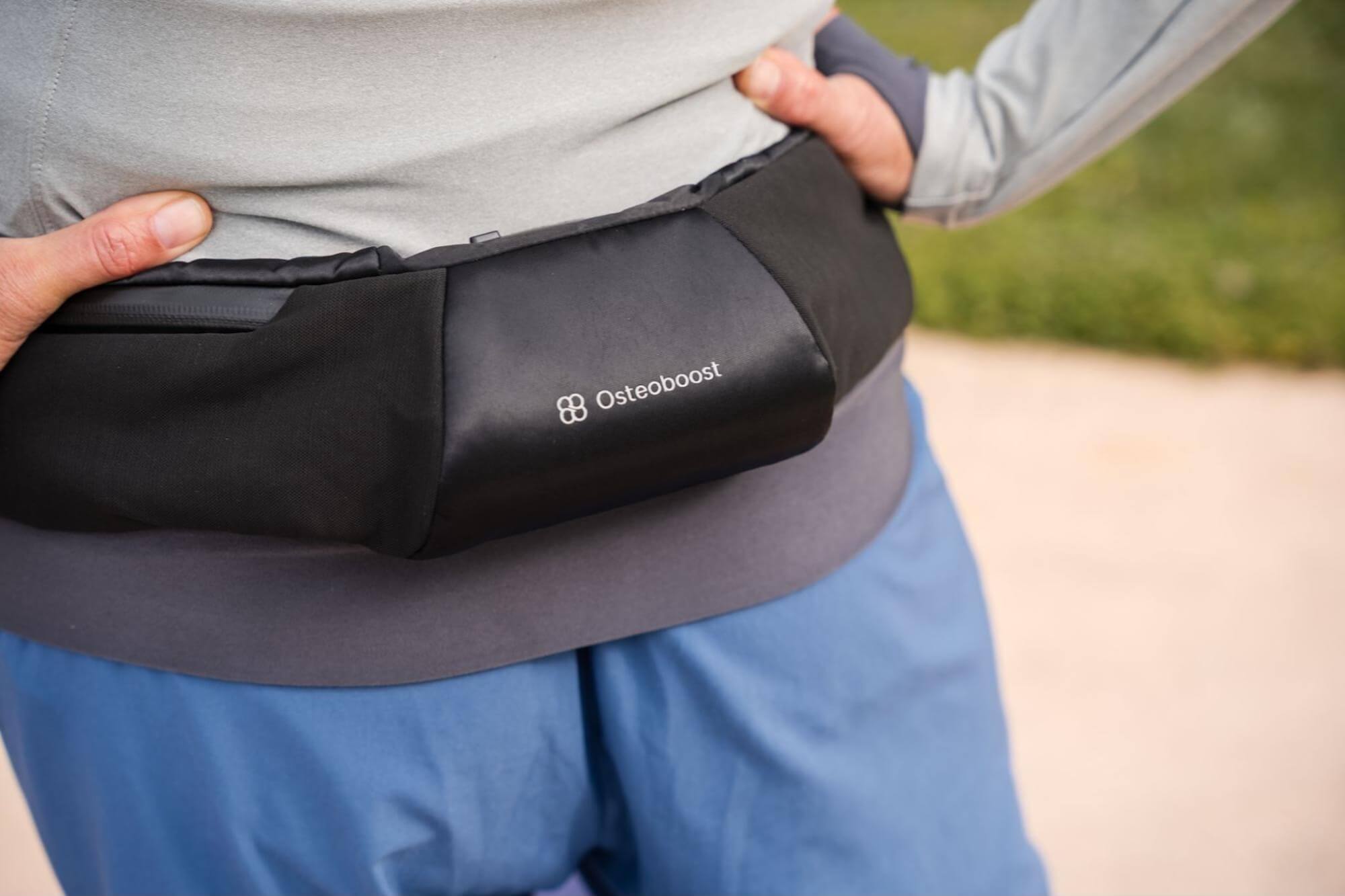
Osteoboost is a vibration device inspired by NASA-funded research on vibration therapy. It uses targeted vibrations to treat osteopenia and reduce bone loss by over 80%.2
You wear the Osteoboost device as a belt, with the vibration pack sitting directly against your sacrum delivering precise vibrations to your spine and hips. If you have osteopenia, these are the areas with the highest risk of life-altering bone fractures.
If you are prescribed to use Osteoboost, you can wear the device for just 30 minutes every day and continue performing daily activities that involve standing or walking while wearing it. Osteoboost is easy and safe: no serious adverse, device-related effects were reported in the clinical trial.
Most importantly, it’s effective. In a 12-month, randomized, double-blinded, sham-controlled clinical trial with the University of Nebraska Medical Center, 64 women were assigned the Osteoboost and 62 to an inactive version of the device.3
The researchers found that those who used the Osteoboost at least three times a week saw:
- an 85% reduction in the loss of vertebral bone density
- an 83% reduction in the loss of vertebral bone strength
- and a 55% reduction in the loss of hip bone density compared to the placebo group
For participants who used the Osteoboost device at least three times per week during the study, 31% also had an increase in bone strength in the spine and 33% had an increase in bone density in the spine.
Learn more about the science behind Osteoboost here.
Why Osteoboost is the only vibration device that’s FDA-cleared for osteopenia
Osteoboost activates the body’s natural and continuous cycle of bone remodeling by using vibration.
Vibration therapy mimics the bone-strengthening mechanisms and effects of high-impact exercise, working as a form of mechanical loading to improve your bone density. More than 50 years of independent studies have illustrated how mechanical vibrations produce key markers of bone formation including COX-2, nitrous oxide, osteocalcin, PGE-2, RANKL, ALP, and type 1 collagen.4,5
While you may have seen other vibration devices on the market that claim to treat osteopenia, Osteoboost works slightly differently. As a result, it’s the only FDA-approved vibration device for bone health.
The most common vibration devices are whole body vibration plates and platforms. These plates deliver vibrations to the bottom of your feet as you stand on them, but research shows that the vibration magnitude dissipates the further you are from the vibration source.6 This makes them great for mechanically stimulating your feet and lower legs, but not for your hips or spine, where most fractures actually occur.
You must also stand still on them for 20 to 30 minutes a day. This is simply not as convenient as wearing a vibration belt and going about the rest of your day.
What’s more, no whole-body vibration plate or platform has ever been approved by the FDA as an effective treatment for low bone density. Meanwhile, Osteoboost has been cleared by the FDA through its De Novo pathway as the only device of its kind to treat osteopenia.
How to use Osteoboost vibration devices
You must have a prescription before receiving and using Osteoboost, but you can purchase a device as you await your prescription. To get a prescription, simply download this form to share with your doctor or request one online for $30 through Beluga Health, our telehealth partner.
After your prescription has been approved and you’ve placed your order, you’ll receive the device and download the Osteoboost app to stay on track with session guidance and daily tracking.
Position the Osteoboost low around your hips, with the vibration pack or cushioned pad on your sacrum and the power button facing up. Secure the device with the magnetic clasp and tighten the straps. This should feel snug and comfortable. If you’re unsure whether the Osteoboost is tight enough, you can check the mobile app as confirmation.
Then, stand still for the device to initiate the pressure check. This should take about four to five seconds to complete. If you hear a double tone, tighten the straps once more.
Once your Osteoboost is fitted properly, you’ll feel a vibration pulse through the device as an indication that it’s calibrating. After calibration is complete, the Osteoboost will automatically transition into a mode of continuous vibration. During every treatment session, the embedded sensors in the device calibrate the needed dose of vibration with acceleration.
You can track your device usage and calcium intake via the app. Including Osteoboost in your daily routine and life is seamless, serving as a valuable and impactful addition to the current standard of care for osteopenia.
Order your device today and start treating your osteopenia.
Exercise and nutrition: Two science-backed lifestyle changes to improve your bone health
An active, healthy lifestyle is an essential and proven part of managing osteopenia and boosting your bone health.7,8
This includes:
- Exercising regularly, including strength training and high-impact exercises
- Eating a balanced and healthy diet, with the nutrients you need for bone health
In this section, we explore what you can do in terms of exercise and nutrition to tackle osteopenia.
It’s worth noting that we recommend using Osteoboost while continuing to pursue a healthy lifestyle. It’ll give your bones the best chance to stay as strong as possible. The more things you do to protect your bones, the better your chances of preserving bone density.
Exercise and osteopenia: How to keep your bones strong
Staying active plays an important role in strengthening your bones as well as your muscles, ligaments, and tendons.
Weight-bearing exercises such as climbing the stairs, dancing, tai chi, hiking, jumping rope, and lifting weights are especially important because they make your body work against gravity and help you build and maintain bone density.
These exercises, as well as any other activity that puts enough physical stress on your bones, activate your bone-forming cells, called osteoblasts, to deposit more calcium and create more bone tissue. This process is called mechanical loading and has been shown to boost bone health.9
We recommend three types of exercises in particular: resistance strength training, high-impact exercises, and core and leg strength training.
Resistance strength training
Resistance strength training using resistance bands, dumbbells, barbells, weight machines, or your own body weight creates significant mechanical loading and stimulates your bones to grow stronger.10
It involves any physical exercise that causes your muscles to contract because you’re using them against some sort of external resistance or force. When your muscles contract against a resisting force, they pull on the bones they’re attached to, stimulating your osteoblasts to build bone density.
Before a resistance strength training workout, you should warm up with a few minutes of stretching and light cardio exercise such as walking or jogging in place. Then, if you want, pick a weight or resistance level that feels comfortable but still challenging for you.
You can mix and match exercises to create your own routine. If you start with resistance strengthening exercises for your legs, you can finish with exercises for your upper body or vice versa. For example:
- Start with a squat and hold a dumbbell vertically to your chest for three sets of 10 to 12 reps.
- Repeat the same number of dumbbell bicep curls.
- Take a resistance band and pull it apart to your sides to create tension for your upper back.
- Finish by lying on your back with your knees bent and feet flat on the ground, placing a mini-band above your knees. Then, squeeze your glutes and push your hips toward the sky.
You’ll want to be able to do at least 12 to 15 repetitions of a movement while breaking a sweat. If at any point you feel pain or discomfort, stop and opt for a lower weight or resistance level. You should also rest between sets for at least one to two minutes to ensure you aren’t straining or overextending yourself.
High-impact exercises
High-impact exercises involve both your feet leaving the ground simultaneously and your bones and joints absorbing the ground reaction forces as you land.
The high forces applied and transmitted through your bones will slow down bone resorption. This also encourages bone formation in regions of high strain by activating your fast-twitch muscle fibers and osteoblasts.
Examples include:
- Burpees
- Jumping jacks
- Knee-highs
- Running
If high-impact exercises are too intense for you, you can try low-impact exercises so you can always keep at least one foot on the ground. Examples include cycling, yoga, and pilates. Swimming is also considered a low-impact exercise because the water’s buoyancy supports your weight and reduces stress on your bones and joints.
High-impact exercises are harder on the body, but yield faster results.11 Realistically, a combination or balance of both high- and low-impact exercises is best. An online program designed specifically for people with osteoporosis, like Buff Bones or Kaari, is the ideal way to learn which exercises you can do safely for bone loss prevention benefits.
Core and leg strength training
Core and leg strength training will support your posture and improve your balance, which will reduce your fall and fracture risk overall.
These movements include:
- Lunges
- Deadlifts
- Squats
- Planks
- Sit-ups
You can also use equipment such as yoga mats, weights, ab rollers, and stability balls for added comfort and targeted focus on your core and legs. Other more fun and creative core and leg exercises include bicycle crunches, Russian twists, and mountain climbers. Make sure you feel comfortable in the starting position for each exercise first before you start any further movements.
For balance exercises to reduce the risk of falls, try Wellen, which is also owned by Osteoboost.
Common barriers to exercise
It’s one thing to know which exercises are good for you, and it’s another to commit to doing them regularly. On its own, we acknowledge that exercising can feel intimidating, exhausting, and painful — and that’s without an osteopenia diagnosis.
In our State of Bones 2026 survey, we found that 68% of women with osteoporosis limit their activities due to fear of fractures. Their fear scales with the severity of their diagnosis and bone density loss. This is completely understandable, as fractures can be life-changing events.
There are other reasons that may make it harder for many people to be as active as they would like, including:
- Physical impairments
- Limited mobility and energy due to older age
- Cost
- Lack of time
- Lack of previous exposure to exercise
- Lack of access to a nearby fitness center
Yet, while all these factors make exercising less accessible, any exercise you can comfortably do is better than not moving at all. Any exercise you can manage will contribute to improving your osteopenia, even if it’s just a small amount each day.
Nutrition and osteopenia: How what you eat can impact your bone health
Nutrition is another crucial part of osteopenia treatment and is essential for bone mineralization, healing, formation, and maintenance.
One of the most important nutrients to ensure you receive enough of is calcium. It is one of the key building blocks of your bones, and it has been found to reduce the risk of fractures and slow the rate of bone loss.12
Foods rich in calcium include:
- Dairy products
- Seafood (sardines)
- Green vegetables
- Nuts
- Beans
- Soy
Another key nutrient is vitamin D, which enhances calcium absorption and also reduces the risk of fractures.12
Great sources of vitamin D include:
- Natural sunlight
- Fish
- Fish liver oils
- Egg yolks
- Mushrooms
- Fortified milk and grains
Other nutrients beneficial to your bone health include:
- Vitamin K (green leafy vegetables)
- Protein (lean meats, fish, and eggs)
- Magnesium (nuts, seeds, and legumes)
- Creatine (meat and seafood)
- Vitamin C (fresh fruits and vegetables)
- Boron (dried fruits and beans)
- Omega-3s (fatty fish and nuts)
- Strontium (whole grains and lentils)
- Collagen (bone broth and animal products)
If you aren’t getting enough of these nutrients from your food, your doctor may recommend over-the-counter supplements for you to take.
Generally speaking, you should receive 1,000-1,200 milligrams of calcium and at least 600 to 800 international units (IU) of vitamin D every day. Absorbing enough calcium and vitamin D is essential not only for your bones but also for your overall health.
We also recommend limiting your alcohol, salt, and caffeine consumption as these can disrupt your body’s balance of calcium. If you smoke, you should try to quit. Nicotine slows osteoblast production and negatively affects your body’s ability to absorb calcium.13
Medications for advanced osteopenia (and the possible side effects to be aware of)
There are a number of osteopenia medications and treatments on the market. The most common are bisphosphonates, parathyroid hormone analogs, lab-made biologic agents, and hormone-based treatments.
All osteopenia medications and treatments are associated with side effects.14 In our research, we found that many people with osteopenia are hesitant to take these drugs as a result.
That said, medications are really only considered as potential options if you’re diagnosed with severe osteopenia. Even then, it’s up to you and your doctor to determine whether they’re the best choice.
Bisphosphonates: Fosamax, Boniva, Actonel, and Reclast
Bisphosphonates are antiresorptive medications that slow down your body’s natural process of breaking down bones. They are the most commonly prescribed medication for osteopenia.
They can come in the form of oral pills that you can take either once a week or once a month and include alendronate (Fosamax), ibandronate (Boniva), and risedronate (Actonel).
Unfortunately, they can also come with unpleasant side effects. These can include general bone and joint pain, nausea, throat irritation, heartburn, difficulty swallowing, stomachaches, and gastric ulcers.15
Those that take bisphosphonates intravenously in the form of zoledronic acid (Reclast), usually once a year, have reported experiencing flu-like symptoms such as fevers and headaches.15
Parathyroid hormone analogs: Tymlos and Forteo
If you have a very high risk of fractures as determined by a DEXA scan or high fracture risk assessment (FRAX) score, your doctor might prescribe parathyroid hormone analogs: a class of anabolic, or bone-building, medications to restore your bone mass.
They work by acting like the hormones your parathyroid glands (behind the thyroid in your neck) produce to stimulate bone formation and growth. These medications are meant to be injected once a day in either your abdomen or thigh, and include abaloparatide (Tymlos) and teriparatide (Forteo).
Common side effects associated with parathyroid hormone analogs include nausea, joint aches, back pain, redness or swelling at the site of injection, headaches, digestive problems, and dizziness or lightheadedness shortly after injection.
Compliance with parathyroid hormone analog medications is also relatively low, partly due to the influence of these side effects.16
Lab-made biologic agents: Prolia and Evenity
Other injectable medications include lab-made biologic agents such as denosumab (Prolia) and romosozumab (Evenity). Prolia is administered once every six months and can be used long-term, while Evenity is administered once every month and should only be used for a maximum of 12 months.
These medications are generally well tolerated, but Prolia may cause body aches, high cholesterol, and decrease your blood calcium levels. Evenity carries increased risks of strokes, heart attacks, and other heart complications.
Hormone-based treatments: SERMs, Evista, calcitonin, and estrogen replacement therapy
Other hormone-based treatments include selective estrogen receptor modulators (SERMs) such as raloxifene (Evista), calcitonin, and estrogen replacement therapy.
Evista can act as estrogen to help maintain your bone density and has been shown to lower the risk of spine fractures.17 Side effects include hot flashes, leg cramps, flu-like symptoms, swollen hands, and joint pain.18
Calcitonin can be administered as either a nasal spray or injection and is a synthetic hormone that can regulate your bone metabolism and regeneration. Typical side effects include nausea, loss of appetite, stomach pain, and digestive issues.19
Estrogen replacement therapy involves supplementing your body with estrogen, essentially replacing the estrogen that women produce much less of during or after menopause.
Due to its severe side effects, doctors tend to avoid recommending estrogen replacement therapy. Studies have shown that people are more likely to develop blood clots in their legs and lungs while on estrogen replacement therapy and become more at risk for strokes, heart disease, and breast cancer.20
If you’ve tried any of these medications and stopped due to the side effects, or if you’re avoiding them altogether and looking for a natural osteopenia treatment that isn’t simply exercise or nutrition, we recommend looking into Osteoboost.
Stay ahead of bone density loss with Osteoboost
If you don’t have an Osteoboost prescription yet, you can still place an order today to reserve your device. Once your prescription is confirmed, we’ll ship it to you for free from our partner pharmacy.
The best natural approach for osteopenia is a combination of a healthy diet, regular exercise, and consistent use of Osteoboost, the only FDA-approved prescription medical device of any kind for treating osteopenia.
Taking action sooner rather than later will preserve the longevity and health of your strong bones and ensure you continue to lead an active life with confidence.
Osteoboost is the only FDA-cleared medical device for bone loss. Purchase your Osteoboost device today.
Frequently asked questions
What’s the difference between osteopenia and osteoporosis?
The difference between osteopenia and osteoporosis is the degree of bone mineral density loss. Osteopenia isn’t as severe, and if left untreated, can progress to osteoporosis. A T-score, or bone density score, between -1 and -2.5 is an indication of osteopenia, and a T-score of -2.5 or lower is an indication of osteoporosis.
How common is osteopenia?
Osteopenia is extremely common. Over 40 million people have osteopenia in the U.S. alone, as do about 40% of people worldwide. It’s been found to affect nearly 50% of women and 30% of men older than 50 years old.21
It has long been viewed as a chronic condition disproportionally affecting non-Hispanic white women.22 However, emerging studies have indicated that lower reported prevalence of osteopenia and osteoporosis among other racial populations has been due to racial and ethnic disparities in bone diagnoses, treatments, and outcomes.
While osteopenia is very common, it usually does not require prescribed medications and instead calls for lifestyle changes to prevent it from progressing to osteoporosis.
What causes osteopenia?
Osteopenia is caused by a variety of factors including normal aging, genetics, family history, health conditions or deficiencies, and certain medications. Menopause is a major risk factor for osteopenia and significantly speeds up bone loss, with osteoporosis being four times more common in women than in men.23 About 42% of postmenopausal women have osteopenia.1
When should you be treated for osteopenia?
We recommend treating your osteopenia once you receive your diagnosis from your healthcare provider with exercise, nutritious eating, and getting an Osteoboost prescription. If your osteopenia is especially severe, your doctor may prescribe you with medications for you to take alongside these natural treatments.
Is osteoporosis preventable if you have osteopenia?
Yes, osteoporosis is preventable if you’ve been diagnosed with osteopenia. You can prevent osteoporosis if you slow down your bone loss and improve your bone strength by exercising, maintaining a healthy diet, taking any medications your doctor prescribes you, and using your Osteoboost every day.
References
- Grili, P., et al. “Nutrient Patterns and Risk of Osteopenia in Postmenopausal Women.” Nutrients, 2023.
- Rubin, C., et al. “A LOW INTENSITY MECHANICAL COUNTERMEASURE TO PROHIBIT OSTEOPOROSIS IN ASTRONAUTS DURING LONG-TERM SPACEFLIGHT.” 2005.
- Bilek, L., et al. “Benefits of Targeted Vibration for Bone Strength and Bone Density in Postmenopausal Women with Osteopenia: A Randomized, Sham-Controlled Trial.” JBMR Plus, 2024.
- Ota T., et al. “Vibrational stimulation induces osteoblast differentiation and the upregulation of osteogenic gene expression in vitro.” Cytotechnology, 2016.
- Clinton R., et al. “Quantity and Quality of Trabecular Bone in the Femur Are Enhanced by a Strongly Anabolic, Noninvasive Mechanical Intervention.” Journal of Bone and Mineral Research, 2002.
- Rubin C., et al. “Transmissibility of 15-hertz to 35-hertz vibrations to the human hip and lumbar spine: determining the physiologic feasibility of delivering low-level anabolic mechanical stimuli to skeletal regions at greatest risk of fracture because of osteoporosis.” Spine (Phila Pa 1976), 2003.
- Liu, J., et al. “Effect of combined exercise and nutrition on bone density in postmenopausal women-a systematic review and meta-analysis.” Nutrition & metabolism, 2025.
- Rondanelli, M., et al. “Nutrition, Physical Activity, and Dietary Supplementation to Prevent Bone Mineral Density Loss: A Food Pyramid.” Nutrients, 2021.
- Sundh, D., et al. “High-Impact Mechanical Loading Increases Bone Material Strength in Postmenopausal Women-A 3-Month Intervention Study.” Journal of bone and mineral research, 2018.
- Hong, A Ram, and Sang Wan Kim. “Effects of Resistance Exercise on Bone Health.” Endocrinology and metabolism, 2018.
- Regnaux, J., et al. “High-intensity versus low-intensity physical activity or exercise in people with hip or knee osteoarthritis.” The Cochrane database of systematic reviews, 2015.
- Voulgaridou, G., et al. “Vitamin D and Calcium in Osteoporosis, and the Role of Bone Turnover Markers: A Narrative Review of Recent Data from RCTs.” Diseases, 2023.
- Al-Bashaireh, A., et al. “The Effect of Tobacco Smoking on Bone Mass: An Overview of Pathophysiologic Mechanisms.” Journal of Osteoporosis, 2018.
- Skjødt, M., et al. “Side effects of drugs for osteoporosis and metastatic bone disease.” British journal of clinical pharmacology, 2019.
- Kennel, Kurt A, and Matthew T Drake. “Adverse effects of bisphosphonates: implications for osteoporosis management.” Mayo Clinic proceedings, 2009.
- Johnson, A., et al. “Compliance With Parathyroid Hormone Analog Medications at a Single Osteoporosis Treatment Center.” Cureus, 2025.
- Messalli, Enrico M, and Cono Scaffa. “Long-term safety and efficacy of raloxifene in the prevention and treatment of postmenopausal osteoporosis: an update.” International journal of women's health, 2010.
- Wooltorton, Eric. “Osteoporosis treatment: raloxifene (Evista) and stroke mortality.” CMAJ : Canadian Medical Association journal = journal de l'Association medicale canadienne, 2006.
- Lall, A., et al. “Evaluation of the impact of calcitonin nasal spray on bone density: A literature review.” The Journal of Foot and Ankle Surgery, 2025.
- Yanachkova, V., et al. “Reconsidering Hormone Replacement Therapy: Current Insights on Utilisation in Premenopausal and Menopausal Women: An Overview.” Journal of clinical medicine, 2025.
- Varacallo M., et al. “Osteopenia.” StatPearls Publishing, 2026.
- Noel, S., et al. “Racial and Ethnic Disparities in Bone Health and Outcomes in the United States.” Journal of bone and mineral research: the official journal of the American Society for Bone and Mineral Research, 2021.
- Alswat, Khaled A. “Gender Disparities in Osteoporosis.” Journal of clinical medicine research, 2017.