NPR on Osteoboost and Protecting Your Bones: Sunlight on a Silent Disease
A few weeks ago, NPR featured Osteoboost in a segment on the popular Morning Edition. It was a watershed moment: not just for us as a company, but for bone health. Finally, this silent disease hidden in the shadows for far too long is in the spotlight.
For a disease this common, osteopenia has had a strange relationship with the public conversation. Everyone over fifty has heard the word. Almost no one has heard it discussed like it matters. That's what made NPR's recent piece on bone density and vibration therapy land differently—it didn't treat the loss of bone strength as background noise. It treated it as news.
The disease we were taught to shrug at
More than 40 million adults in the U.S. over 50 live with osteopenia—the early loss of bone density that can progress to osteoporosis. It is staggeringly common, and it has been staggeringly quiet, treated less like a diagnosis than a forecast: something to expect, manage privately, and live around. We've built a cultural shorthand for women's bones getting weaker with age, as though that were simply the cost of getting older, rather than a process we actually have tools to influence.
Andrea Bloom knows that moment of recognition well. At 57, a routine bone scan put her a tenth of a point from an osteoporosis diagnosis. "It was pretty shocking," she told NPR. It's a small distance with a large meaning — and it's the same distance millions of women are standing at without knowing it.
From zero gravity to your living room
The science here has an unlikely origin story. The vibration technology behind Osteoboost traces back to NASA-funded research into how astronauts could protect their bones in zero gravity—an environment where the absence of mechanical stress causes bone to deteriorate quickly. The insight that came out of it: bone needs a signal to keep rebuilding itself, the kind ordinarily generated by walking, carrying weight, and muscle contraction. Most of us aren't in orbit, but plenty of us aren't getting enough of that signal either.
The number that changed the conversation
We designed Osteoboost around that science, then tested it the way a medical device should be tested: a randomized, double-blind, placebo-controlled trial of 126 women in their fifties and older—the FDA-reviewed study behind Osteoboost's clearance for postmenopausal women with osteopenia.
Over 12 months, the placebo group lost 2.84% of spinal bone strength. The Osteoboost group lost 0.5%—an 83% reduction in spinal bone strength loss.
"When you wear the belt, you're stimulating those bone-building cells." — Dr. Pamela Peeke, Chief Medical Officer, Osteoboost Health, on the mechanism behind Osteoboost (as quoted in NPR)
Worth saying plainly: this trial measured bone strength, not fracture risk, and Osteoboost targets the spine and hips rather than the whole skeleton. That's deliberate—the spine and hip are where a fracture carries the most serious consequences. Osteoboost is one part of a bone-health routine, not a replacement for weight-bearing exercise, calcium, vitamin D, and sleep. [Link: full trial details]
Andrea's story, in her own words
We were thrilled when Osteoboost customer Andrea Bloom agreed to participate in the NPR story. She had previously shared with us how well the belt was working for her and her encouraging DEXA scan results.
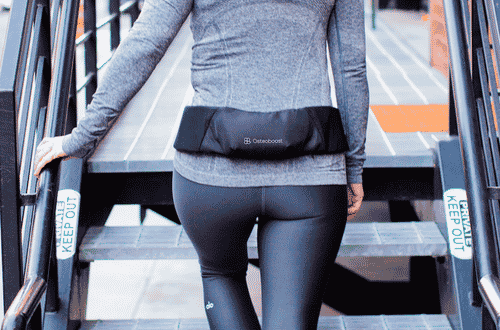
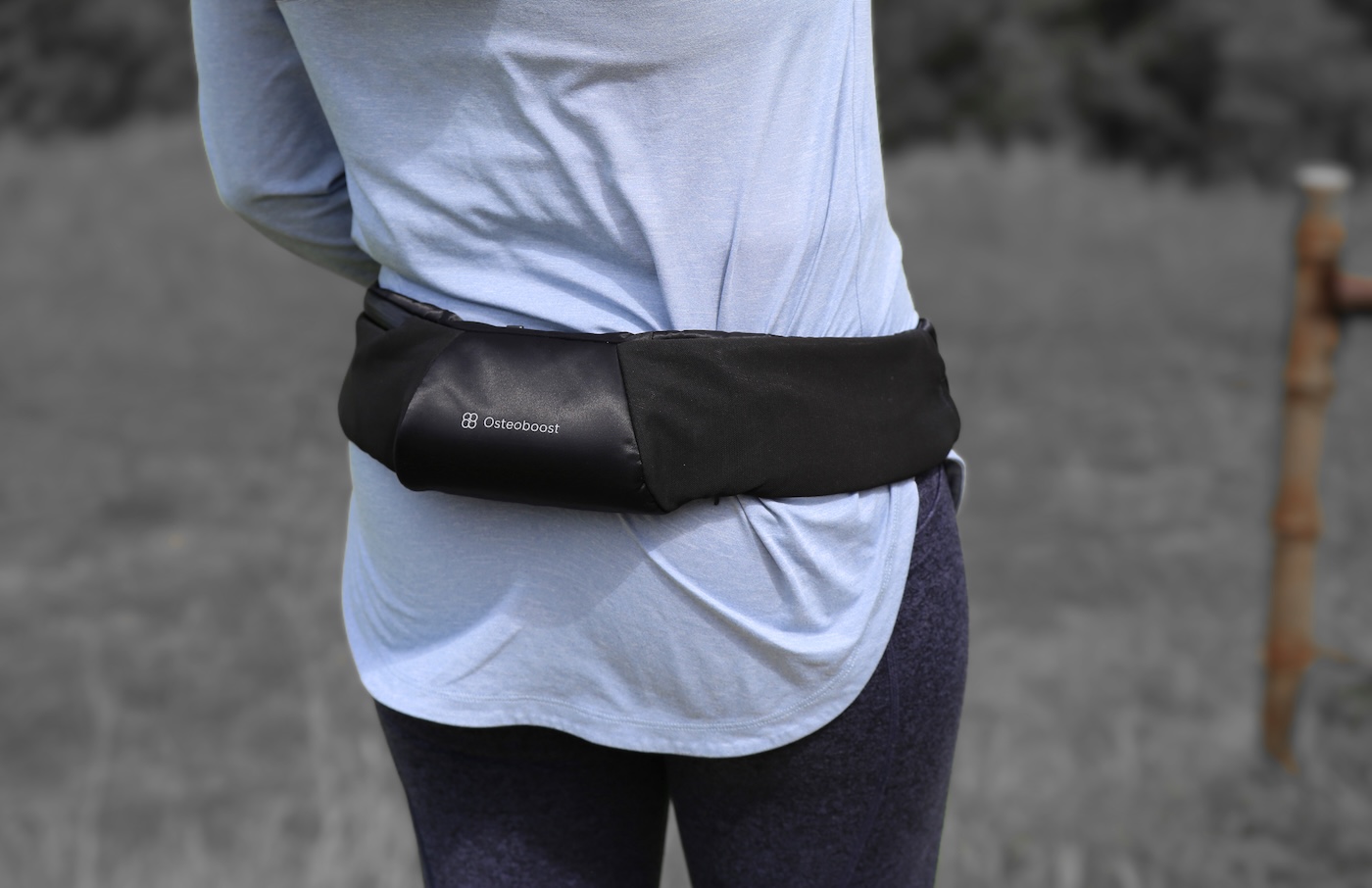
As she told NPR, Andrea wears her Osteoboost most mornings, twenty to thirty minutes at a time, often while walking her dog. It's become routine enough that she described the sensation to NPR as "a very, very light vibration," easy to fold into a day rather than around it. Her most recent bone density scan showed meaningful improvement. She'll tell you it isn't the only thing she changed: more cardio, more dried plums, and lately, jump rope, since she'd heard that's particularly good for bone health too. But the scan doesn't lie, and neither does she: something is working.
This is bigger than a product
Here's why a 3-minute radio segment matters so much to us as a team who has spent years building a medical device. Every public conversation about osteopenia chips away at the idea that bone loss is just something women endure quietly. It pushes someone toward the bone density scan they've been putting off. It pushes a doctor toward a conversation about prevention instead of just calcium pills. It pushes a dinner table past "must be getting old" into something more useful.
That shift in the conversation is the actual win here. Bigger than any single device, including ours. If you read about Andrea and felt that same jolt of recognition, you don't have to just wait and see what happens next. Ask your doctor whether Osteoboost is right for you. Look at the clinical trial data yourself. Or just go get the scan you've been putting off. Forty million of us are in this together, and for the first time in a long time, the conversation is catching up to the disease.
— Laura Yecies, CEO & Co-Founder, Bone Health Technologies