Women Aren’t Ignoring Bone Health. The Healthcare System Is Reaching Them Too Late

We have spent too long treating bone health like something women can deal with later. The problem is that “later” is often when the window of opportunity for prevention and maximizing bone preservation has already passed.
Bone loss does not begin at diagnosis. It builds quietly during midlife, years before a scan or fracture happens. The menopause transition is when changes start accelerating, and yet most women don’t learn their bones are at risk until much later.
This is the real story from our inaugural State of Bones Report.
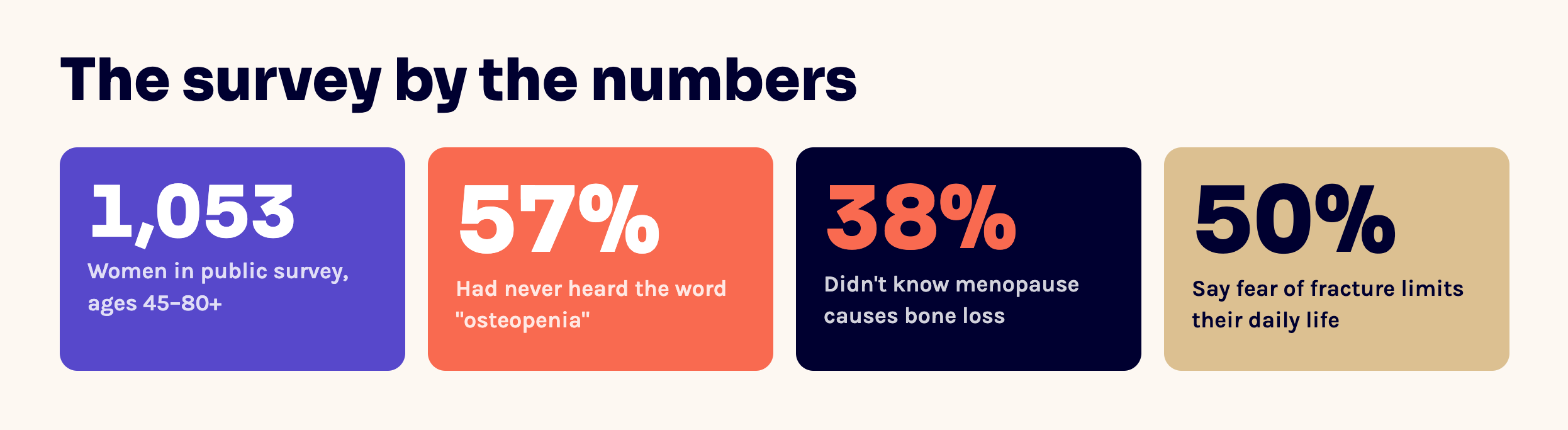
We surveyed over 1,000 women ages 45 and older across the U.S. to better understand what women know about bone health, how supported they feel, and what conversations they are having with their doctors. And at the same time, we also surveyed our own community. What we found across the board wasn't apathy. It was women who care, moving through a critical stage of life without the information they need to act, actively looking for answers.
Nearly two-thirds of the women we surveyed said they are worried about their bone health as they age. That alone challenges one of the most persistent assumptions in this category: that women simply are not concerned until something breaks.
The bigger issue is that concern is not translating into action because too many women are moving through this stage of life without the information they need. In the public survey, nearly 40% of women did not know that menopause and bone loss are connected. More than half had never heard of osteopenia, the stage of low bone density that comes before osteoporosis. Nearly half of women over 45 had never had a DEXA scan.
Maintaining bone health isn't a motivation problem. It's an information problem.
The system is missing women when timing matters most
What concerns me most is where these gaps are showing up. The years surrounding menopause are when bone loss accelerates fastest, and this is where we see the biggest gaps.
Among women ages 55 to 59, nearly three-quarters had never heard of osteopenia, and 71% had never had a DEXA scan.
We cannot keep treating osteoporosis as if it begins at diagnosis. By then, the process has often been underway for years.
Once women get into the conversation, the picture improves
Here's what gives me hope: when women do get DEXA screened, more than three-quarters say their doctor explained the results clearly.
That suggests the biggest breakdown is not necessarily what happens after a diagnosis. It is getting women into the conversation early enough for prevention to still be meaningful.
Only 45% of women said a doctor regularly discusses bone health with them. More than a third said the topic has never come up. Nearly half had never raised it themselves because they didn't know they should.
That is how a silent condition stays silent.
This is also a trust issue
One finding that stayed with me was how unsupported many women feel.
Only 31% said they feel very supported and informed when it comes to protecting their bone health. Nearly half said they do not believe bone health is taken as seriously as other women’s health issues.
That perception has real consequences. When women don't understand what's happening in their bodies, when they leave appointments without a clear picture or a plan, hesitation follows. What they're asking for isn't complicated: affordable options, science-backed, effective treatments, a way to track progress, and clear information about risk.
Earlier conversations would change the outcome
The most hopeful takeaway from this report is that the problem is solvable.
Women care. They want information. Science-backed information from experts. They want to make informed decisions. They want options that fit their lives.
What is missing is earlier intervention and more consistent communication.
Bone health needs to become a routine part of midlife care, especially during menopause, when the opportunity to intervene is greatest. What this report makes clear is that women are ready for that conversation. Too many just are not having it early enough.
To read the full State of Bones Report, click here.